Vaccine for Melanoma
English
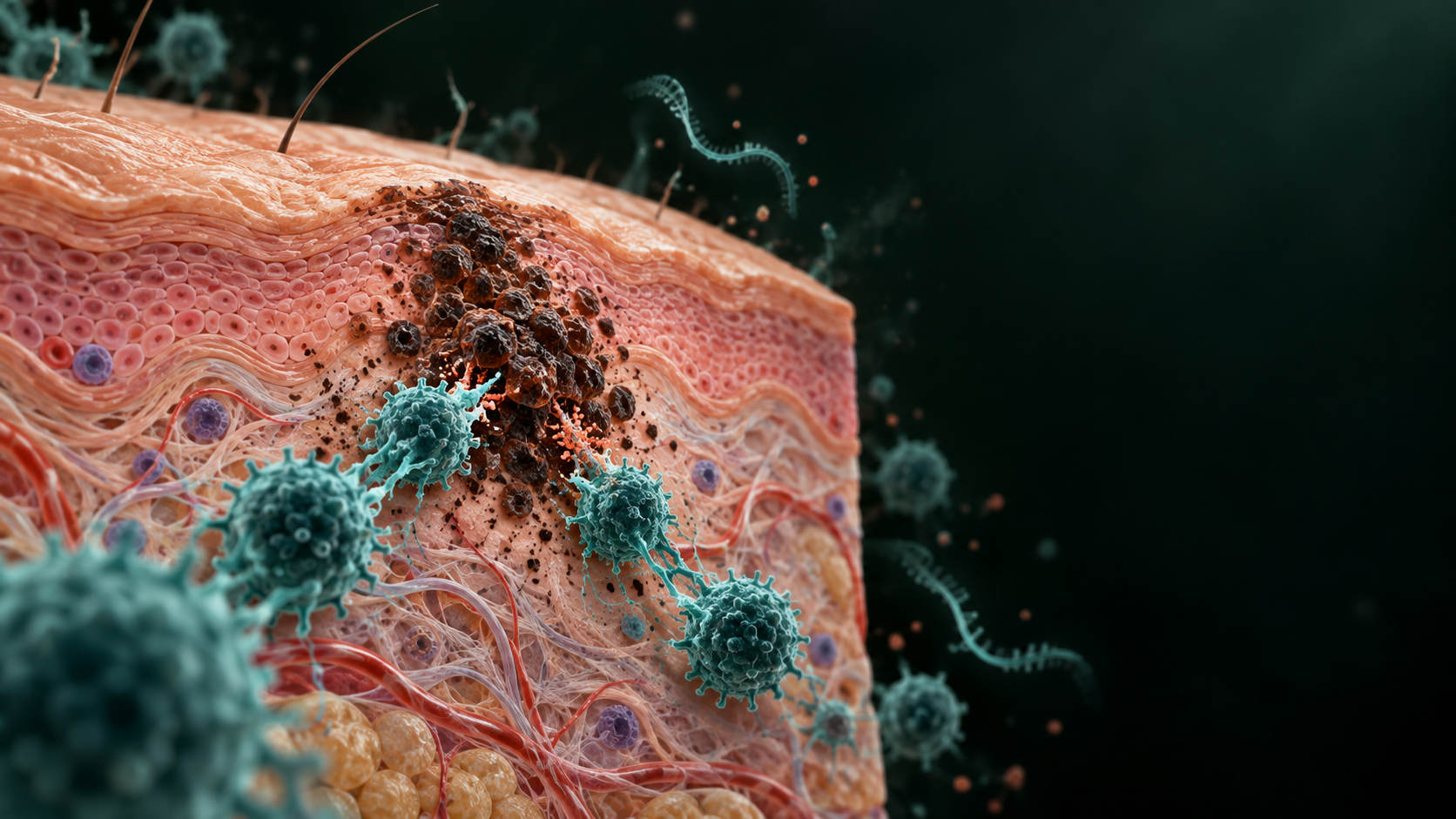
Scientific skin cross-section showing melanoma cells and immune cells

The most mature personalised-vaccine signal

Vaccine for
Melanoma

A tailored mRNA vaccine combined with pembrolizumab reduced recurrences in a randomized phase 2b study. Phase 3 must determine whether that promise holds.

Current positionV940/intismeran autogene remains investigational. Checkpoint immunotherapy and targeted therapy are established care in appropriate settings.
157randomized phase 2b participants
79%estimated recurrence-free at 18 months with V940 plus pembrolizumab
62%with pembrolizumab alone
Phase 3double-blind confirmation underway

KEYNOTE-942

A real randomized signal, with important limits

The study enrolled people with completely resected high-risk cutaneous melanoma. It tested recurrence prevention, not shrinkage of visible metastatic tumours.

Randomized phase 2b

V940 plus pembrolizumab after surgery

Participants were assigned 2:1 to personalised mRNA-4157/V940 plus pembrolizumab or pembrolizumab alone. The vaccine encoded up to 34 patient-specific tumour neoantigens.

At 18 months, estimated recurrence-free survival was 79% with the combination and 62% with pembrolizumab alone. Recurrence or death occurred in 22% versus 40%; the hazard ratio was 0.561, with a two-sided p value of 0.053.

Grade 3 or worse treatment-related adverse events occurred in 25% with the combination and 18% with pembrolizumab alone. No vaccine-related grade 4 or 5 event was reported.

Why phase 3 mattersThe trial was open-label and relatively small, and the primary analysis narrowly missed its prespecified conventional statistical threshold. Longer follow-up and a larger blinded trial are needed.

What kind of vaccine?

Treatment after diagnosis, not a substitute for prevention

The word vaccine describes immune training, even when given therapeutically.

01

Personalised neoantigens

Tumour and normal DNA are sequenced. Algorithms select mutations likely to be recognized by that person's T cells, and mRNA instructions are manufactured as an individual vaccine.

02

Checkpoint combination

Pembrolizumab releases a PD-1 immune brake; the vaccine attempts to expand tumour-specific T cells. The combination is intended to generate and sustain recognition of residual melanoma cells.

Immunotherapy for melanoma
03

Preventive research

No vaccine currently prevents UV-induced melanoma. Sun protection, avoiding tanning beds, risk-aware skin examination and prompt assessment of changing lesions remain the practical prevention and detection tools.

No guarantee: vaccination may reduce recurrence risk without preventing every local recurrence, nodal relapse or distant metastasis. Follow-up remains essential.

Melanoma is not only cutaneous

Site and molecular biology change treatment

V940 phase 2b evidence came from resected high-risk cutaneous melanoma and should not automatically be transferred to every subtype.

Most common

Cutaneous melanoma

Arises from skin melanocytes. Superficial spreading, nodular, lentigo maligna and acral melanoma have different patterns. BRAF status can determine targeted-treatment options.

Palms, soles and nails

Acral melanoma

Often less related to ultraviolet exposure and molecularly distinct from common sun-exposed cutaneous melanoma. Nail-unit lesions can be mistaken for trauma or pigment changes.

Eye

Uveal melanoma

Arises inside the eye, with distinct genetics and a tendency to spread to the liver. Systemic treatment and clinical-trial evidence differ substantially from cutaneous melanoma.

Mucosal surfaces

Mucosal melanoma

Can arise in nasal, oral, anorectal or genital mucosa. It is rare, often diagnosed late and biologically distinct.

Unknown primary

Melanoma without an identified skin primary

May present in lymph nodes or distant sites, possibly after immune regression of the original lesion. Diagnosis requires expert pathology and staging.

Trial eligibility is subtype-specific. Ask whether evidence came from cutaneous, acral, mucosal or uveal melanoma and whether the disease was resected or measurable.

Early recognition

A changing lesion deserves attention

Use ABCDE as a memory aid: asymmetry, border irregularity, colour variation, diameter or difference from other lesions, and evolution. The “ugly duckling” that looks unlike a person's other moles can also matter.

Do not wait for every textbook sign

  • A new or changing pigmented or non-pigmented lesion
  • A rapidly growing firm nodule
  • Bleeding, crusting, itching, pain or a sore that will not heal
  • A dark streak or changing pigment under a nail
  • New visual symptoms or a pigmented lesion in the eye

Most changing lesions are not melanoma, but photography or an app cannot replace dermoscopic examination and biopsy when clinically indicated.

Established care matters

Vaccines enter a field already transformed by immunotherapy

Management depends on stage, resectability, subtype, BRAF mutation and prior treatment.

Surgery

Excision remains central for localized melanoma. Sentinel-node and further staging decisions depend on depth, ulceration and other pathological features.

Checkpoint immunotherapy

PD-1, CTLA-4 and LAG-3-directed treatments are established in selected adjuvant and advanced settings, with potentially serious immune-related toxicities.

Targeted therapy

BRAF plus MEK inhibition is effective for suitable BRAF V600-mutant melanoma. It is not interchangeable with vaccination or checkpoint therapy.

Clinical trials

Match the exact disease setting

Search by subtype, stage, resected versus measurable disease, mutation status and previous immunotherapy.

Connected guides

Research, treatment and practical preparation

Research tools

Follow the evidence

A 2026 JAMA review discusses both the established oncolytic-virus treatment T-VEC and the promising, still investigational V940 plus pembrolizumab recurrence-prevention study. The latter still needs phase 3 confirmation.